
Hinge Review
Subscription type:
Payments:
Compatibility:
Pros
- Prompts make starting conversations easier: There's always something specific to respond to, so nobody has to open with "hey."
- The algorithm actually learns: Use the feedback features honestly, and the recommendations get sharper over time.
- Free tier pulls its weight: Eight likes a day is a real constraint, but the core experience works in active markets without spending anything.
- Date feedback is a genuinely smart feature: Most apps are blind to what happens after a match. Hinge at least tries to learn from it.
Cons
- Eight likes a day goes fast: Serious users burn through it quickly, and the reset at 4 a.m. adds unnecessary friction.
- Thin results outside big cities: The smaller your market, the less the app can do — paid features included.
- Selfie verification is unreliable: A notable number of current Google Play reviews flag it as broken, with repeated failures and no clear fix.
- HingeX is a tough sell: At $49.99 a month, the boosting features only justify the price in high-traffic cities.
- Auto-renewal catches people off guard: It rolls over automatically — unless you turn it off before the billing date.
"Designed to be deleted." That's Hinge's pitch, and unlike most dating app slogans, the product actually backs it up.
Most apps are built to keep you on them. More swipes, more notifications, and more reasons to open it again tomorrow. Hinge goes the other direction. It wants to get you into a relationship and off the platform, and that thinking shows up in how the app is built, not just how it's marketed. Whether it delivers in practice is a fair question, and this review answers it honestly.
Here's what Hinge offers in 2026, what it costs, and who it works for.
What Is Hinge?

Hinge is a dating app built for people who want a real relationship. Not just something to scroll through on a slow evening. You build a profile, browse other people's, and connect with those you like. What sets it apart from most dating apps is how that profile gets built and how those connections start — but more on that shortly.
On the business side, Hinge launched in 2012, scrapped its original format and rebuilt from scratch in 2016, and was then acquired by Match Group in 2019. It runs under the same parent company as Tinder, but operates on its own and feels nothing like it.
The app is available on iOS and Android.
Profiles on Hinge are built around written prompts — questions users answer. So, there's something real for potential matches to react to, rather than a stack of photos and a bio nobody reads. It's a small structural change that shifts how the whole app feels.
Who Uses Hinge?
Hinge skews toward adults in their mid-twenties to late thirties who are looking for a real relationship. Not a situationship. It has grown fastest in the U.S., U.K., and Canada, where it was the top-growing dating app in 2022 by its own numbers. Think of it as sitting past Bumble on the seriousness scale — the people on it are generally thinking about where things could go.
How Does Hinge Work?
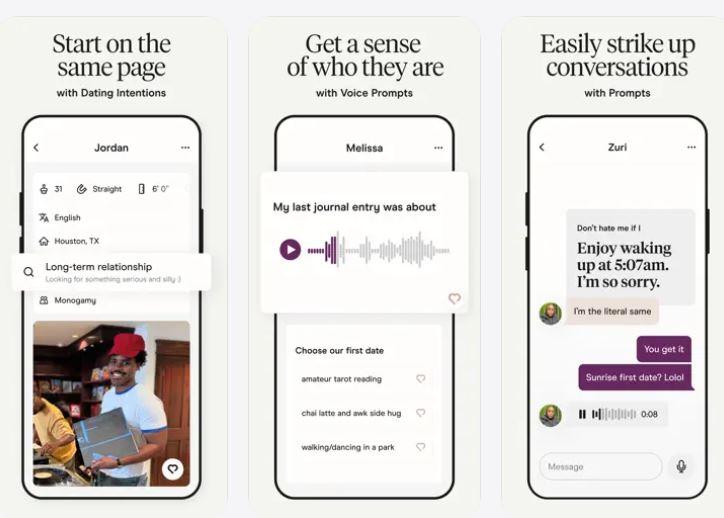
You pick three prompts from a library of hundreds, write your answers, add photos, and optionally throw in voice notes, video, and details like your religion, family plans, and whether you want kids. The end result is a profile that tells someone something about you.
Browsing works differently, too. There's no swipe feed. You scroll through full profiles and like or comment on specific parts — a photo, a prompt answer, and a voice note. Every match starts from that, which means opening conversations have something to work with rather than both people staring at a blank message box.
Key Features
Here's how Hinge's main features work in practice.
Prompts and Profile Depth:
Three written prompts anchor every profile. The library has hundreds of options, from easy icebreakers to questions that reveal something. You can update them anytime. Hinge's own data shows that adding a comment to a like gets you three times more responses than a like alone — a worthwhile return on a few extra seconds.
The Algorithm:
Hinge uses a matching framework based on the Nobel Prize-winning Gale-Shapley stable matching model. It watches what you like, what you write, and how you rate dates. Then it adjusts what it shows you. Once a day, it puts forward one "Most Compatible" match. It takes a little time to get useful, but it does improve as you give it more to work with.
Roses
A Rose is a stronger signal than a standard like. Sending one pushes your profile to the top of someone's likes queue so that it's less likely to get buried. Free users get one Rose per week. Additional ones can be bought separately, outside of any subscription.
Selfie Verification
Hinge lets users verify their identity through a selfie check. It's optional, not required, but verified profiles tend to carry more weight with other users. The system has had some technical frustrations — more on that in the cons — but the intent is straightforward: reduce fake profiles.
Convo Starters
A newer addition that generates personalized conversation ideas based on a match's answers and photos. It's there for people who blank on what to say first, and it's more useful than it sounds because the suggestions are tied to the profile rather than being generic.
Date Feedback
After you exchange numbers, Hinge checks in to ask how things went. That feedback goes back into the algorithm. It's a small thing, but it's one of the smarter design decisions on the app — most platforms have no idea what happens after a match, so they can't learn from it.
Mobile App
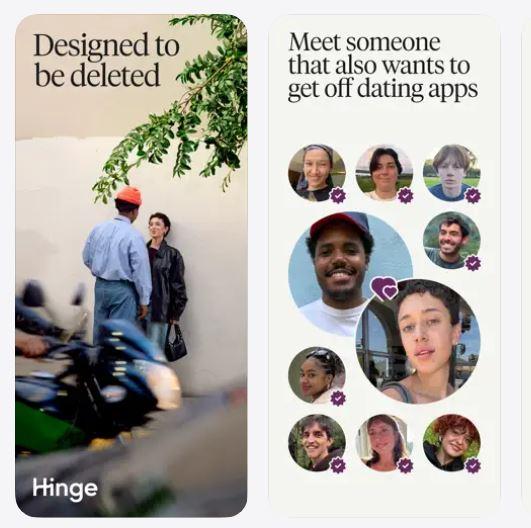
Both iOS and Android apps are fully featured. The Android version has a 3.7-star rating from 438,000 reviews on Google Play as of May 2026. The interface is clean, though if you're used to swipe-based apps, the layout takes a session or two to get comfortable with.
Hinge Pricing
The free version gets you more than most apps offer at that level. You can build a full profile, send up to eight likes a day, and message your matches. In a busy city, that's enough to get real traction without spending a dollar.
Two paid tiers are available when you want more.
Hinge+
At $32.99 per month (or $64.99 for three months and $99.99 for six), Hinge+ removes the daily likes cap, lets you see your full list of incoming likes at once rather than one at a time, and adds advanced filters for height, family plans, politics, education, and more.
HingeX
At $49.99 per month (or $99.99 for three months and $149.99 for six), HingeX includes everything in Hinge+. It also adds three features: Skip the Line, which keeps your profile boosted continuously in other users' feeds; Priority Likes, which pushes your outgoing likes to the top of recipients' queues; and Enhanced Recommendations, which surfaces more compatible profiles earlier in your browsing.
For most people, Hinge+ is the better call. HingeX's boosting features only deliver their full value in cities with enough active users for the visibility bump to actually matter. In a smaller market, you're paying for something that has nowhere to go.
Roses and Boosts are also available as one-off purchases for users who'd rather not commit to a subscription. Subscriptions auto-renew — turn off auto-renewal in your account settings before the billing date if you don't want it to roll over.
Who Is Hinge For?

Hinge works well for adults in larger cities who want a relationship and are comfortable putting some actual effort into their profile and conversations. The app rewards people who engage with it properly. Write insightful prompts, make real comments, and use the feedback function, and the experience becomes significantly better.
It's a poor fit for people in smaller cities or rural areas where the user base is sparse. It also doesn't work well for people looking for something casual, anyone who wants to browse without putting out a detailed profile, or users who aren't going to bother personalizing their messages.
Is Hinge Safe?
Hinge puts more into safety than most apps at this level. Selfie verification helps confirm users are real. The platform automatically filters comments it flags as potentially disrespectful and lets users block specific language from incoming likes. There's a Trust and Safety section on the website and a Safety Center inside the app itself.
The Google Play data safety disclosure notes that Hinge may collect and share location, personal information, and other data types. Reading the privacy policy at hinge.co/privacy before signing up is worth doing if that matters to you.
Tips for Getting More From Hinge
Keep these in mind:
- Put real effort into your prompts: Bland answers attract bland interest. Pick questions that show something specific about you and write answers that are easy to respond to.
- Always comment when you like someone: Three times the response rate with a comment versus a like alone, per Hinge's data. A couple of seconds, genuinely worth it.
- Use date feedback every time: The algorithm needs honest input to improve. Skip those prompts, and it stays guessing.
- Test the free tier before upgrading: If profiles in your area are already thin, a subscription won't fix it. Try widening your distance filter first.
- Refresh your prompts every few weeks: It gives people who've already seen your profile a reason to take another look.
FAQs
Is Hinge free to use?
Yes. Free accounts get up to eight likes a day, full profile creation, and messaging with matches. Hinge+ starts at $32.99 per month, and HingeX at $49.99 per month.
How does Hinge's algorithm work?
It's based on the Nobel Prize-winning Gale-Shapley stable matching model and learns from your behavior over time — who you like, what you comment, and how you rate dates. The more you use it honestly, the better it gets at putting relevant people in front of you.
What is a Rose on Hinge?
A Rose signals a stronger interest than a regular like and moves your profile to the top of that person's queue. Free users get one per week. More can be bought individually.
How do I cancel my Hinge subscription?
Turn off auto-renewal in your account settings before your next billing date. On iOS, manage it through your Apple ID. On Android, through Google Play.
The Verdict
Hinge earns its reputation. The prompt format produces genuinely better conversations than photo swiping, the algorithm improves in ways you can feel, and the design philosophy — building an app that tries to get you off the app — isn't just marketing. It shows up in the features.
The frustrations are real, though. Eight likes a day is a tight ceiling for anyone using the app seriously. Results thin out fast outside major cities. HingeX's pricing is hard to defend unless you're somewhere with enough active users to make the boosting features work. And selfie verification, while well-intentioned, has let down a fair number of users technically.
If you want something real and you're willing to put in the effort the platform asks for, Hinge is one of the better options out there in 2026. Download it for free, build a profile that's worth responding to, and see where it goes.